Wednesday, October 09, 2013


Thursday, August 29, 2013
Report on the Peaceful Protests Crackdown by Moroccan Forces in Elaiun on August 27th,2013
Report on the Peaceful Protests crackdown by moroccan Forces in Elaiun on August 27th,2013
Coinciding with the visit of the EU delegation to Western Sahara , which is headed by Assistant Special Rapporteur for Human Rights in the European Union Mr. Jounathan Lis, the Saharawi population organized large demonstrations at the Semara boulevard at 6:30 pm on August 27th,2013 calling for the stopping of the depletion and the plundering of the Saharawi natural resources. The mass denounced the conclusion of the new fisheries agreement protocol between the EU and Morocco, which includes the waters of the occupied Western Sahara. In the new protocol, there is no mentioning whatsoever of the situation of the Western Sahara nor the respect of the international law vis-a-vis the respect of the aspirations and the demands of the local Saharawi inhabitants.During the demonstration,People cried out loud for independence, and chanted pro-independence slogans calling for an independent state . Such slogans were like :"There is no alternative but self determination", " A Saharawi independent state is the only solution," "Long live the Popular Front for the Liberation of Sakia El Hamra and Oro de Oro "," O Saharawi! don't get fed up, for independence is the only solution ".
The Smara Boulevard witnessed a heavy long besieging reinforced by the different security forces including: the repressive "the auxiliary forces" , the plain-cloth police agents , the uniformed police and many known torturers like: (Nabil Aouni ) and ( Mohammad Alalgi ) ,the Pasha of Elaaiun city: ( Nashta Mohammed ) and ( Mustafa al-Husseini ) nicknamed " the Moustahce" . These forces poured its anger on the peaceful Saharawi civilian demonstrators who were savagely beaten up and kicked so badly with sticks, batons and stones , This resulted in the severe injury of dozens of Saharawivictims:
Leila Leili, Sidi Mohamed Dadash, Abdul Rahman Zeyou,Limam Sleima, Habib Al-Salhi, Meryem Bourhimi, Lafqir Bemba , Nezha Khatatri,Mahfouda LAfqir, Yaya Sukeina,,Ghaliya Joumani,Braih Farrik,Albad Mahjoub, Heydoug Azerqi,Aid Alghardag,Rgaibano Lahwaiyj,Oum Lakhout Lafqir,Lhassan Ghardag, Haddhoum Farriq and Sallam Abra.
The disperse of these peaceful demonstrators crowds by force is considered a real violations of the human rights and is a prevention of peaceful protest that is guaranteed by international law. All these violations happen in Elaaiun and all other parts of Western Sahara on a regular systematic and daily basis. Saharawi cities are are all under siege and are by far militarized cities.
Report by: Saharawi Center for Media and Communication.
Elaaiun, Western Sahara.
Sunday, August 11, 2013
Tuesday, July 16, 2013
Video from the Washington Post:In Western Sahara, a forgotten struggle
http://www.washingtonpost.com/posttv/video/thefold/in-western-sahara-a-forgotten-struggle/2013/07/12/cc0a07c8-eaf8-11e2-8f22-de4bd2a2bd39_video.html
Friday, June 21, 2013
Wednesday, April 17, 2013
U.S. proposes U.N. Western Sahara rights monitor; Morocco warns of "missteps"
UNITED NATIONS/RABAT (Reuters) - The United States has proposed that the U.N. peace-keeping mission in the disputed territory of Western Sahara help monitor human rights there, U.N. diplomats said on Tuesday, an idea that has prompted an expression of regret from Morocco.
The U.S. proposal was contained in a draft U.N. Security Council resolution Washington circulated to the so-called Group of Friends on Western Sahara, which includes the United States, France, Spain, Britain and Russia, U.N. diplomats said on condition of anonymity.
"The U.S. has proposed a human rights-monitoring component for the U.N. in Western Sahara," a diplomat said. Other diplomats, as well as the Robert F. Kennedy Centre for Justice and Human Rights, confirmed his remarks.
The draft resolution is intended to extend the mandate of the U.N. mission in Western Sahara for another year. It is scheduled to be put to a vote later this month.
Morocco's government responded to the U.S. proposal by cancelling the annual "African Lion" war games in protest.
In a statement, it said the country was "confident in the wisdom of the members of the Security Council and in their ability to find appropriate formulas to preserve the political process from any missteps that would have significant and detrimental consequences on the stability of the region."
African Lion is an annual joint military exercise with the Moroccan Armed Forces and the U.S. Army involving around 1,400 U.S. and 900 Moroccan soldiers.
U.N. diplomats said France, which traditionally supports Rabat, was also unhappy with the U.S. proposal.
The U.S. suggestion for a human rights monitoring component of the U.N. mission in Western Sahara, known as MINURSO, comes after Secretary-General Ban Ki-moon told the Security Council in a report that he advocated "sustained" independent human rights monitoring for the territory.
The idea of permanent U.N. human rights monitoring is something Morocco opposes but rights groups and the Polisario Front independence movement have long advocated.
RIGHTS VIOLATIONS?
A spokesman for the U.S. mission to the United Nations, Payton Knopf, confirmed Washington was discussing the issue. "We are actively reviewing MINURSO's mandate and are working closely with our U.N. Security Council partners on this issue," he said.
"The United States continues to support the U.N.-led process designed to bring about a peaceful, sustainable and mutually agreed solution to the conflict whereby the human rights of all individuals are respected," Knopf added.
In U.N.-mediated talks, Rabat has tried to convince Polisario, which represents the Sahrawi people, to accept its plan for Western Sahara to be an autonomous part of Morocco.
Polisario instead proposes a referendum among ethnic Sahrawis that includes an option of independence, but there is no agreement between Morocco and Polisario on who should participate in any referendum.
The referendum has never been held and attempts to reach a lasting deal have been unsuccessful.
No state recognizes Morocco's rule over Western Sahara but the Security Council is divided. Some non-aligned states back Polisario but France, a veto-wielding council member, has continued to support Rabat.
Polisario accuses Morocco of routine human rights violations in Western Sahara and has called for MINURSO to have the authority to conduct independent human rights monitoring. That is something Polisario has called for in previous years, but Morocco, backed by France, has rejected the idea.
In his report, Ban argued in favour of some form of independent rights monitoring but offered no details on how it would be carried out in the resource-rich territory.
"Given ongoing reports of human rights violations, the need for independent, impartial, comprehensive and sustained monitoring of the human rights situations in both Western Sahara and the (refugee) camps becomes ever more pressing," Ban said.
(Reporting by Lou Charbonneau and Aziz El Yaakoubi; Editing by Todd Eastham)
Copyright © 2013 Reuters
http://thestar.com.my/news/story.asp?file=%2F2013%2F4%2F17%2Fworldupdates%2Fus-proposes-un-western-sahara-rights-monitor-morocco-warns-of-missteps&sec=Worldupdates
Friday, March 29, 2013
Ross's meeting with Saharawis in Mauritania
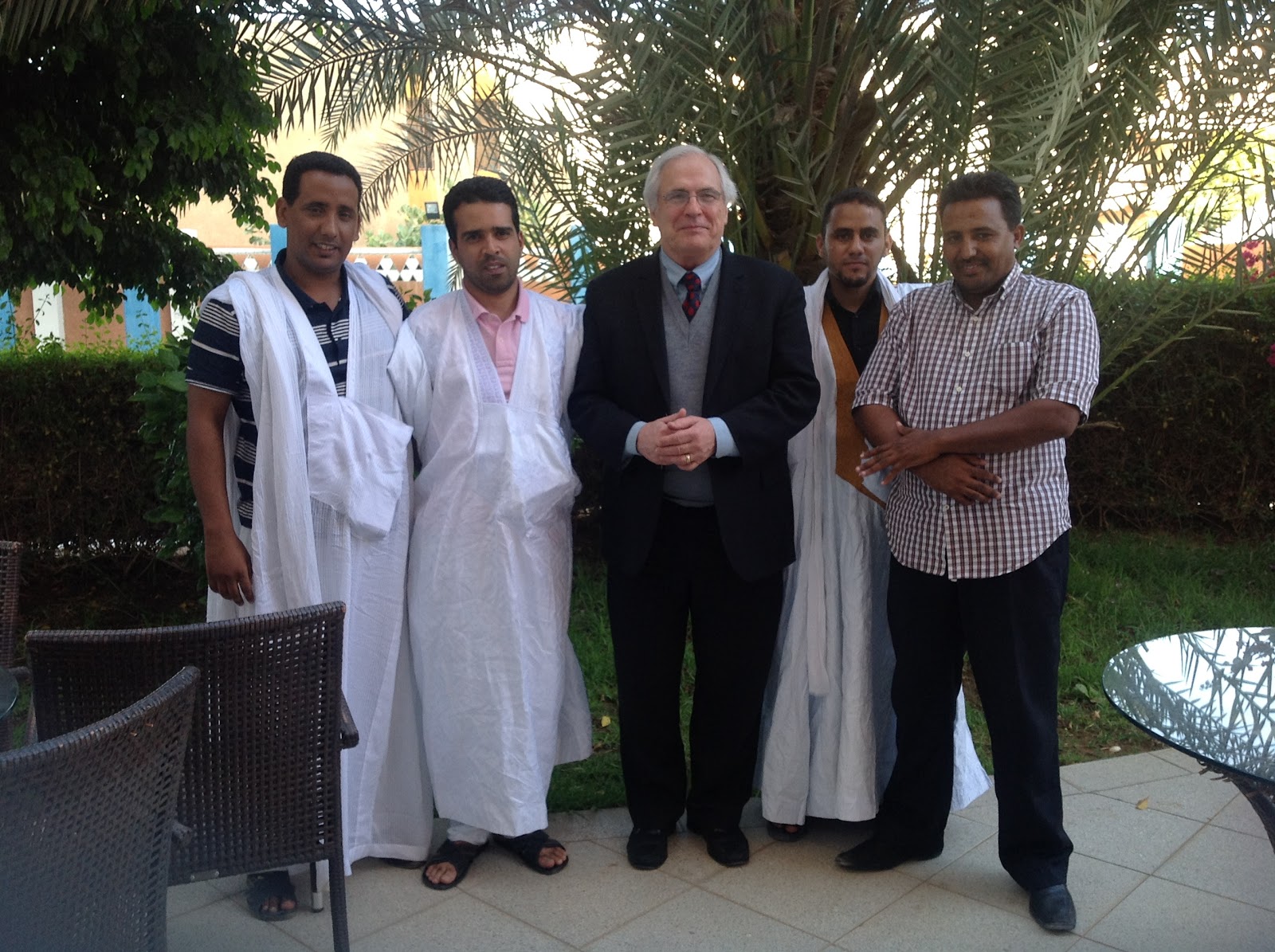 جري يوم الأربعاء الموافق لي 27 مارس 2013 في مدينة انواكشوط الموريتانية لقاء مع سعادة السفير كرستوفر روس المبعوث الشخصي للأمين العام للامم المتحدة ، وجري هذا اللقاء الذي دام ساعة وربع في مدينة انواكشوط بموريتانيا ـ وقد تمحور اللقاء حول المحاور المتعلقة بالجوانب
سياسي
حقوقي
إجتماعي
إقتصادي
والظروف التي يعيشها الإنسان الصحراوي في الأرض المحتلة وفي اللجوء والشتات وخصوصا الواقع المزري الذي يعيشه الانسان الصحراوي في الارض المحتلة من الصحراء الغربية خاصة الاحداث الاخيرة ،وكذا تداعيات التماطل وغض الطرف عن الانتهاكات المستمرة التي ترتكبها السلطات المغربية ضد الشعب الصحراوي
وكان الحديث شيقا مع السفير روس
اللقاء حضره :
عن الأرض المحتلة الناشطين السياسيين والحقوقين الصحراويين
محمد المصطفي أهل تكرور
محمد البيكم
عن الجاليات الصحراوي في موريتانيا كل من :
لدهم الداهي صالح لعروسي النوف
محمد ولد الشيخ أريه المبروك
جري يوم الأربعاء الموافق لي 27 مارس 2013 في مدينة انواكشوط الموريتانية لقاء مع سعادة السفير كرستوفر روس المبعوث الشخصي للأمين العام للامم المتحدة ، وجري هذا اللقاء الذي دام ساعة وربع في مدينة انواكشوط بموريتانيا ـ وقد تمحور اللقاء حول المحاور المتعلقة بالجوانب
سياسي
حقوقي
إجتماعي
إقتصادي
والظروف التي يعيشها الإنسان الصحراوي في الأرض المحتلة وفي اللجوء والشتات وخصوصا الواقع المزري الذي يعيشه الانسان الصحراوي في الارض المحتلة من الصحراء الغربية خاصة الاحداث الاخيرة ،وكذا تداعيات التماطل وغض الطرف عن الانتهاكات المستمرة التي ترتكبها السلطات المغربية ضد الشعب الصحراوي
وكان الحديث شيقا مع السفير روس
اللقاء حضره :
عن الأرض المحتلة الناشطين السياسيين والحقوقين الصحراويين
محمد المصطفي أهل تكرور
محمد البيكم
عن الجاليات الصحراوي في موريتانيا كل من :
لدهم الداهي صالح لعروسي النوف
محمد ولد الشيخ أريه المبروك
Thursday, March 21, 2013
Saturday, March 16, 2013
Sunday, March 10, 2013
Thursday, February 28, 2013
Tuesday, February 26, 2013
The Life of a Saharawi Student in the Occupied Territory of Western Sahara
The Life of a Saharawi Student in the Occupied Territory of Western Sahara.
By: Mohamed Brahim, Feb 23rd,2013.
Ismail Hamdi, a Saharawi student, is from Elaaiun where he was born and raised. When he first opened his eyes to this world, he saw oppression, abuses, and plundering of natural resources. He has been witnessing occupation at work in his homeland: Western Sahara.
Throughout the years, he was never able to understand why Saharawis, who never invaded any other nations or any other neighboring territories, were invaded in 1975 by Morocco, and thus the never-ending journey of suffering and terror begun. Ismail kept asking himself questions repeatedly all the time as he saw himself growing up and then going to school. He could not help but to realize the Sahara was never and could never be Moroccan or moroccanized.
At school, Ismail was always aware of the forged history they have all been taught at the hands of Moroccan teachers. He could sense bitterness and resent amongst his Saharawi classmates building up and mounting each day. During Moroccan national holiday, they were all forced to learn by heart the Moroccan national anthem, and to sing it loudly in the main halls of schools while saluting the Moroccan flag. They were even forced to go on day-long festive parades wearing the Moroccan flag colors chanting slogans praising the king and his dynasty.
As years went by, Ismail has become a bright student. He was highly admired and was a very distinguished student amongst his peers. He was even excelling in foreign languages namely in French which most Saharawis despised and disliked. Most Saharawis believe that France is Morocco’s legal guardian and protector. They think that France is the ultimate accomplice of the Moroccan regime and is behind the continuity of their ongoing misery. Saharawis prefer Spanish and English language.
Ismail Hamdi is a bright, cultured and a well-disciplined Saharawi who is always getting good grades and is regarded as an icon in his small Saharawi community. Most Saharawis are bright students and very intelligent. Therefore, they are an easy target for the Moroccan regime through the appointed teachers who all dislike this fact. The Moroccan -run schools have, unofficially, a secret instructions agenda to keep the Saharawis underrated and below the education’s average “national guidelines”. Unfortunately enough, most Moroccans have been brainwashed to go against whatever is Saharawi. The settlers rejoice when they see their children get good grades, and they would hate themselves when they see a Saharawi student score high! Moroccan teachers in Western Sahara are just another arm for the regime to misinform the Saharawis. Some teachers would even ignore Saharawis students raising their hands high up wanting the permission to speak when in the classroom, but soon enough they are all ignored and not given the opportunity to participate. Most often, Saharawis are not given the chance to take part in workshops and educational training while Moroccan students enjoy that benefit in Morocco.
Ismail would always laugh when he would see the Moroccan secret service plain-cloth agents trying to blend in with the students in and outside the schools. It was very obvious they did not belong in there. Even a small kid can tell! Very often, Ismail and other Saharawis were chased by the police officers in police vans and by some “Ghoulish looking” undercover cops whenever there is a peaceful demonstration calling out for the right of Self Determination for Saharawis. Usually, Ismail and his friends would use graffiti on the walls of the schools to express their refusal of the oppression and their condemnation of the plundering and abuses taking place in the Western Sahara. In the peaceful demonstrations, Saharawi students would raise the Saharawi flag as an indication to their ultimate and most honored demand: “Independence for Western Sahara”.
These kind of brave amateur acts have proven to be very effective in irritating the Moroccan regime and the local authorities. This same regime is always plotting against the Sahrawis including the kids. They wanted to break the will of the Saharawis at any price. They started building strategies and mobilizing their institutions towards achieving their schematic plans. The local authorities, under the supervision of the police and the intelligence services agents, introduced drugs into schools and encouraged drug dealers to sell it at lower prices to Saharawis. Cocaine has become popular. For them, it is just another tool to exterminate the Saharawis. Selling drugs at lower prices was a bait to lure young Saharawis into moving to the: “Wasteland”. Ismail, wittingly, noticed this new phenomenon and alerted his people. His friends and him watched and watched for days and weeks. Their suspicions were confirmed. The authorities were behind this drug trafficking at schools. The secret government agents supplied and facilitated the access to the merchandise and encouraged the addiction among teenagers. The aim was to make Saharawis drug addicted in order to lure them away from politics and to subdue them. The motto is” Get away from politics and do whatever you want”. The demand for the right of self-determination is a no-no for the Moroccan regime. Saharawis, upon this blatant discover, engaged themselves into fighting the drugs that became widespread in their environment. These efforts paid back. The risks have been minimized to the least. Saharawi students have become aware of the dangers around them in their own backyards.
Ismail Hamdi is a proud dignified Saharawi. He always thinks of himself as a member of a very distinguished authentic society that has special characteristics of its own. Wearing a Saharawi Darraa is always a privilege for him and for his peers. It is considered an act of cultural resistance. It is about self-assertion.Darra3a for males and Melhfa for females. These traditional clothes are symbols of the national identity. Far more than that, it is now, in these special circumstances, to preserve the national Saharawi heritage. To Ismail’s dismay, the Moroccan administration placed a ban on wearing such clothes: no male Saharawi dress is allowed in schools. This unofficial statement is brutally enforced especially on Saharawi national holidays that are prohibited in the occupied territory. Clear enough, wearing the Darraa on the school premises was considered a plot against the regime. Oddly enough, this was another war against anything that makes Saharawis look different than the Moroccans. It is just another tactic of assimilation conducted and run by any occupation force throughout known history.
Ismail Hamdi is about to get his baccalaureate soon. He wants to go to the university to pursue his undergraduate studies since he has big plans for the future. Needless to say, there are no universities in Western Sahara. It is a sad thing, but the Moroccan regime never wanted to build colleges or universities in there. Ismail is sharing his frustration and worried with his friends: How would Moroccan students in Morocco treat a young ambitious patriotic Sahrawi? With fear? Contempt? Loathing? Or-perhaps worse: violence and total aggressiveness? Disregard? He thinks most of them would say” He is trouble, stay away from him!”
Wednesday, February 20, 2013
Saturday, January 26, 2013
Thursday, January 24, 2013
Thursday, January 03, 2013
Inside disputed Western Sahara - Features - Al Jazeera English
Inside disputed Western Sahara - Features - Al Jazeera English
Laayoune, Western Sahara - "Duck down and put your head below the window," says Hamid as we pass a military outpost in southern Laayoune, the capital of Western Sahara, on our way to the family home of dissident activists here.
Laayoune has no shortage of military outposts. The security forces are everywhere, on hand to disperse protests and public demonstrations. The latest incident was on December 10 - International Human Rights Day - when they broke up a protest in front of an office of Morocco's Advisory Council on Human Rights with clubs.
Western Sahara has been ruled by Morocco since 1975 when, after Franco's death, the Spanish left and allowed Morocco and Mauritania to enter. An International Court of Justice advisory opinion issued at the time did not find "any tie of territorial sovereignty" between Western Sahara, Morocco, and Mauritania, though it also noted the "difficulty of disentangling the various relationships existing in the Western Sahara region at the time of colonisation".
By 1979, internal resistance had forced Mauritania out, but Morocco's King Hassan II was committed to the Sahara as "bilad al-siba", part of a "Greater Morocco" that would eventually cover all of Mauritania as well. Hundreds of thousands of Moroccan settlers were encouraged to enter Western Sahara with state-subsidised property and employment, under the army's protection.
| Inside Story - Tensions in Western Sahara |
Morocco then fought a war against an indigenous Sahrawi group of fighters, the Frente Polisario, which ended in 1991 when the UN brokered a ceasefire and pledged to hold an independence referendum within six months.
The referendum has still not been held. Morocco retains control of Western Sahara and its lucrative phosphate and fishing resources. The country is now the last United Nations-designated "non-self-governing territory" in Africa, and is home to between 100,000 and 140,000 Moroccan military personnel (despite a total population of just 500,000).
The referendum has still not been held. Morocco retains control of Western Sahara and its lucrative phosphate and fishing resources. The country is now the last United Nations-designated "non-self-governing territory" in Africa, and is home to between 100,000 and 140,000 Moroccan military personnel (despite a total population of just 500,000).
Morocco's reigning King Muhammad VI has said that "the issue of our Saharan provinces is central" in order "to complete our territorial integrity".
Life under Moroccan rule
The fighting drove much of the indigenous population of Western Sahara into refugee camps in Tindouf in southern Algeria, but some remain as a minority within the territory, west of the 2,600-kilometre separation wall that Morocco built during the war with the Polisario.
The UN peacekeeping mission, MINURSO, has limited jurisdiction: unusually for such missions, the UN Security Council has not given it a mandate to monitor rights abuses. Nor is it sufficiently staffed: the mission has only six police officers and 237 military personnel covering an area larger than Britain. MINURSO staff said they need an additional 10 civilian police just to monitor their own compound.
The fighting drove much of the indigenous population of Western Sahara into refugee camps in Tindouf in southern Algeria, but some remain as a minority within the territory, west of the 2,600-kilometre separation wall that Morocco built during the war with the Polisario.
The UN peacekeeping mission, MINURSO, has limited jurisdiction: unusually for such missions, the UN Security Council has not given it a mandate to monitor rights abuses. Nor is it sufficiently staffed: the mission has only six police officers and 237 military personnel covering an area larger than Britain. MINURSO staff said they need an additional 10 civilian police just to monitor their own compound.
Media access in Western Sahara is extremely restricted: almost no foreign journalists are given permits to enter, and the occasional groups of journalists who are allowed in have their movement controlled by the state. Accordingly, little is known about the lives of the Sahrawi in the disputed territory.
"Our group is underground," Fatima Tobarra, president of the Sahrawi Observatory for Women and Children, told Al Jazeera. "We tried to make an official organisation, but the authorities refused even to receive our application, so we can have no premises."
"Our group is underground," Fatima Tobarra, president of the Sahrawi Observatory for Women and Children, told Al Jazeera. "We tried to make an official organisation, but the authorities refused even to receive our application, so we can have no premises."
Neither the Moroccan police nor the Moroccan government's human rights department responded to requests for comment for this article.
 |
Life expectancy is just 54 years in Western Sahara, tellingly lower than Morocco's 72. The Observatory says discrimination and abuses against the local population are rampant."The police here guard the schools, and intimidate the Sahrawi children, then inside they are discriminated against by the teachers who are almost always Moroccans, so attendance drops," said Tobarra.
"Our children are not even allowed to join the activity groups that the Moroccan children have, so we run groups for them."
Khouaja Youssef, the Observatory's general secretary, says that women she has spoken to have told her that, in the past, security forces have been caught by parents giving hard drugs to very young Sahrawi children to get them addicted. "They hate us, and they don't want us here - they'll do anything to hurt and injure our communities," Youssef said. The allegations could not be independently verified.
Many of the families have had relatives killed or "disappeared". Fatima's own father and uncle were split up as refugees, and neither have been heard from since. Her grandfather and grandmother were both jailed in Agdz prison, and died there, she said.
"We cannot live like this, and we will not," Fatima said. "We want our self-determination so that we can live good lives. The people in other countries, in Tunisia, in Yemen, they won their freedom - and we want that to happen here. It has to happen here."
Repressing resistance
Despite the extensive security apparatus, the Sahrawi have been holding demonstrations against Moroccan rule, and what they see as their second-class citizenship, for years.
This peaked in October 2010, with the establishment of the Gdeim Izik protest camp: a tent city set up by activists south-east of Laayoune. The camp was forcibly dismantled by the Moroccan police, and between 11 and 36 Sahrawi were killed as well as eight members of the Moroccan security forces.
A group called Coordination Gdeim Izik played a key role in the protest camp, and continues to organise regular non-violent demonstrations in Laayoune, Smara, and Dakhla. Most recently, they organised a protest on International Human Rights Day in front of the Moroccan Human Rights Organisation (CCDH) office in Laayoune.
The protest was forcibly broken up, and many - like Salimah, a Sahrawi woman in her late twenties - were beaten. "I was very badly attacked. They smashed my teeth to pieces and I had to get them reconstructed," she said, displaying the artificial replacements that now lie in place of her lower front six teeth. "The police came to the protest out of their uniforms and beat us with clubs."
Another young member, Khalil, said that the security forces have become adept at pre-empting and breaking up protests, routinely using clubs and batons against anyone who attends. "They do not care if you are young, old, man, woman - if you come to the protests they will attack you," he said.
Some demonstrators have lost their lives in the protests. Maryem Dambar says she watched her brother, Said Dambar, be shot in the head by police at a protest near his own house in Laayoune in December 2010.
"Our children are not even allowed to join the activity groups that the Moroccan children have, so we run groups for them."
Khouaja Youssef, the Observatory's general secretary, says that women she has spoken to have told her that, in the past, security forces have been caught by parents giving hard drugs to very young Sahrawi children to get them addicted. "They hate us, and they don't want us here - they'll do anything to hurt and injure our communities," Youssef said. The allegations could not be independently verified.
Many of the families have had relatives killed or "disappeared". Fatima's own father and uncle were split up as refugees, and neither have been heard from since. Her grandfather and grandmother were both jailed in Agdz prison, and died there, she said.
"We cannot live like this, and we will not," Fatima said. "We want our self-determination so that we can live good lives. The people in other countries, in Tunisia, in Yemen, they won their freedom - and we want that to happen here. It has to happen here."
Repressing resistance
Despite the extensive security apparatus, the Sahrawi have been holding demonstrations against Moroccan rule, and what they see as their second-class citizenship, for years.
This peaked in October 2010, with the establishment of the Gdeim Izik protest camp: a tent city set up by activists south-east of Laayoune. The camp was forcibly dismantled by the Moroccan police, and between 11 and 36 Sahrawi were killed as well as eight members of the Moroccan security forces.
A group called Coordination Gdeim Izik played a key role in the protest camp, and continues to organise regular non-violent demonstrations in Laayoune, Smara, and Dakhla. Most recently, they organised a protest on International Human Rights Day in front of the Moroccan Human Rights Organisation (CCDH) office in Laayoune.
The protest was forcibly broken up, and many - like Salimah, a Sahrawi woman in her late twenties - were beaten. "I was very badly attacked. They smashed my teeth to pieces and I had to get them reconstructed," she said, displaying the artificial replacements that now lie in place of her lower front six teeth. "The police came to the protest out of their uniforms and beat us with clubs."
Another young member, Khalil, said that the security forces have become adept at pre-empting and breaking up protests, routinely using clubs and batons against anyone who attends. "They do not care if you are young, old, man, woman - if you come to the protests they will attack you," he said.
Some demonstrators have lost their lives in the protests. Maryem Dambar says she watched her brother, Said Dambar, be shot in the head by police at a protest near his own house in Laayoune in December 2010.
| "We live here always under the eyes, and under the clubs of the Moroccans." - Lahib Salhi, Coordination Gdeim Izik leader |
The Moroccan security forces then attacked the house, clubbing Maryem and her mother after she fled inside. The police subsequently denied all responsibility for Said's death, and to this day refuse to admit that the killing happened, or to investigate it.
"All our family wants is justice for Said," Maryem said. "I saw him killed, and cannot understand how the Moroccans can deny that they murdered him. If there were any human rights in Western Sahara, Said's death would not be denied, and his killers would be brought to justice."
"All our family wants is justice for Said," Maryem said. "I saw him killed, and cannot understand how the Moroccans can deny that they murdered him. If there were any human rights in Western Sahara, Said's death would not be denied, and his killers would be brought to justice."
The case may not be unique. Human Rights Watch has complained that Moroccoan authorities failed to follow-up on the beating of the group's research assistant in 2010, calling the attack a "case study of impunity for police violence".
"If there is impunity for police who beat up a citizen who works for an international organization in broad daylight, in front of witnesses and despite formal complaints, it's clear how vulnerable ordinary citizens are," Sarah Lee Whitson, a Human Rights Watch spokesperson, said in a March 2012 statement.
In April, Amnesty International reported that: "Sahrawis advocating self-determination for the people of Western Sahara remained subject to restrictions on their freedoms of expression, association and assembly, and leading activists continued to face prosecution."
Despite the danger of documenting unrest - anyone caught filming or taking pictures of protests in Western Sahara faces punishment, and usually the destruction of the camera equipment - Coordination Gdeim Izik say they have video evidence of the attacks on their protests.
In one video seen by this reporter, a 55-year-old woman is savagely beaten and kicked to the floor by two riot policemen; in another, uniformed military personnel beat a young girl so severely she had to be hospitalised, according to her friends. A senior member of the group, Sidi Muhammad Ramadiy, pointed to the screen and said: "This is human rights for Morocco."
The group's de facto leader, Lahib Salhi, said: "We live here always under the eyes, and under the clubs of the Moroccans. The world must do what it promised to do when the UN first came: hold the referendum, and give us the chance to live as we wish to live."
Five thousand kilometres from Palestine
There are clear parallels between the situations in Western Sahara and in Palestine, campaigners say. Both involve the exit of former imperial powers, the arrival of forces from outside, alleged repression of the indigenous population, and the protection of the status quo by permanent members of the UN Security Council.
Despite the danger of documenting unrest - anyone caught filming or taking pictures of protests in Western Sahara faces punishment, and usually the destruction of the camera equipment - Coordination Gdeim Izik say they have video evidence of the attacks on their protests.
In one video seen by this reporter, a 55-year-old woman is savagely beaten and kicked to the floor by two riot policemen; in another, uniformed military personnel beat a young girl so severely she had to be hospitalised, according to her friends. A senior member of the group, Sidi Muhammad Ramadiy, pointed to the screen and said: "This is human rights for Morocco."
The group's de facto leader, Lahib Salhi, said: "We live here always under the eyes, and under the clubs of the Moroccans. The world must do what it promised to do when the UN first came: hold the referendum, and give us the chance to live as we wish to live."
Five thousand kilometres from Palestine
There are clear parallels between the situations in Western Sahara and in Palestine, campaigners say. Both involve the exit of former imperial powers, the arrival of forces from outside, alleged repression of the indigenous population, and the protection of the status quo by permanent members of the UN Security Council.
France actively supports Morocco's position, and although the US nominally supports holding the referendum, it has made no moves to resolve the conflict or to push for monitoring of human rights abuses. The UK, China, and Russia have largely remained silent.
But while the Israel-Palestine conflict is one of the most high-profile news stories in the world, that in the Western Sahara remains little-known.
Despite the complexity of the situation at the UN, many Sahrawis blame the international community. "The Moroccans make the claim on our land because they can, because they are strong and because they are supported by France, the United States, and Britain," said Salhi. "But they know the claim is false. The Mauritanians once claimed Western Sahara for themselves. Where are they now? How much longer will the world permit this injustice?"
Subscribe to:
Posts (Atom)